Employee Engagement Activities for Production Employees: Practical Standards That Actually Work
In many organisations, engagement programs are designed with office staff in mind — town halls, flexible policies, brainstorming sessions, digital platforms. But what truly drives engagement on the shop floor is very different.
Employee engagement activities for production employees must reflect operational realities: shift systems, physical work, safety concerns, output targets, and limited digital access.
When these realities are ignored, engagement initiatives feel irrelevant and participation drops. If engagement is meant to improve morale, productivity, and retention, it must be tailored to the workforce structure.
Why Engagement Looks Different in Production Environments
Production employees operate in environments where:
Work is structured and repetitive
Performance is output-based
Safety is critical
Communication flows top-down
Recognition is often informal
Traditional engagement models that work for office staff — like idea forums or innovation workshops — may not translate directly to factory settings.
Reflective Question:
Are your engagement initiatives designed for corporate employees but applied to factory workers?
Standard Employee Engagement Activities for Production Employees
Below are practical, structured engagement approaches that align with operational realities.
1. Daily Shift-Level Communication Huddles
Short, structured daily meetings before shift start improve clarity and belonging.
What works:
5–10 minute stand-up meetings
Safety reminders
Production targets
Recognition of previous day achievements
Quick feedback channel
Example:
A manufacturing unit introduced structured daily huddles. Within three months, communication errors reduced and near-miss safety incidents declined significantly. This is one of the most effective employee engagement activities for production employees because it builds visibility and shared ownership.
2. Performance-Linked Recognition Systems
Production employees respond strongly to visible, measurable recognition.
Effective recognition models:
Weekly performance boards
Safety milestone awards
Attendance consistency rewards
Skill-based certification recognition
Team-based output bonuses
Case Insight:
A mid-sized FMCG plant implemented team-based performance dashboards. Instead of rewarding individuals only, teams were recognised publicly. This improved collaboration and reduced internal friction. Recognition must be structured and transparent to sustain motivation.
3. Skill Development and Multi-Skilling Programs
Growth opportunities increase engagement significantly in operational environments.
Best practices:
Machine cross-training programs
Safety certification upgrades
Lean process training
Internal promotions linked to skill matrix
When workers see a path to advancement, engagement improves naturally.
Engagement Question:
Do your production employees see long-term growth, or only daily output targets?
4. Safety-Centered Engagement Culture
In production settings, safety is engagement.
Practical initiatives include:
Safety suggestion schemes
Monthly safety awards
Incident transparency reporting
Supervisor safety walkthroughs
Anonymous reporting channels
When employees feel protected, they feel valued.
5. Structured Feedback Channels for Shop Floor Workers
Engagement fails when communication flows only downward.
Low-cost initiatives:
Suggestion drop boxes
Shift-level feedback representatives
Monthly plant head open sessions
Simple QR-based feedback tools
Unlike office staff, production workers may not use email or Slack — systems must match access realities.
Employee Engagement for Office Staff: How It Differs
While production environments focus on structure and safety, engagement for office staff often centres around:
Autonomy and ownership
Flexible policies
Innovation platforms
Career planning
Recognition beyond compensation
Office staff engagement activities may include:
Quarterly town halls
Internal mobility programs
Cross-functional projects
Learning stipends
Recognition portals
The key difference lies in the motivation drivers:
Production employees value stability, safety, recognition, and skill growth. Office employees value autonomy, development, purpose, and flexibility.
Common Mistakes in Production Employee Engagement
Many organisations make these errors:
Copying corporate engagement models for factory staff
Overcomplicating engagement with digital tools
Ignoring shift-based communication
Focusing only on salary increments
Not linking engagement to measurable output
Employee engagement activities for production employees must remain simple, structured, and consistent.
Practical Engagement Framework for Production Units
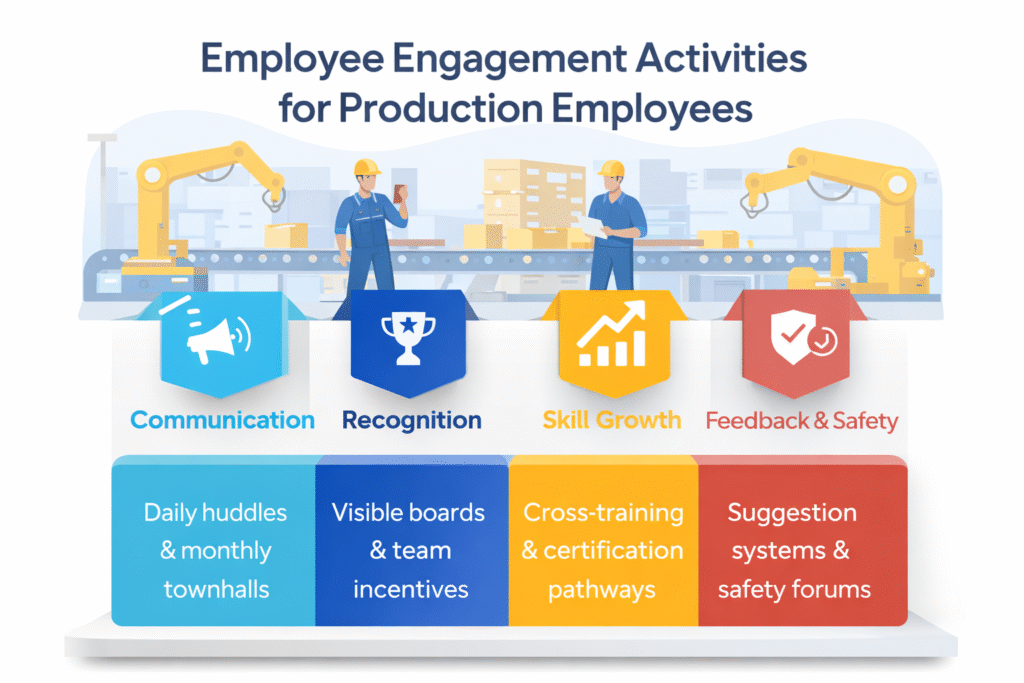
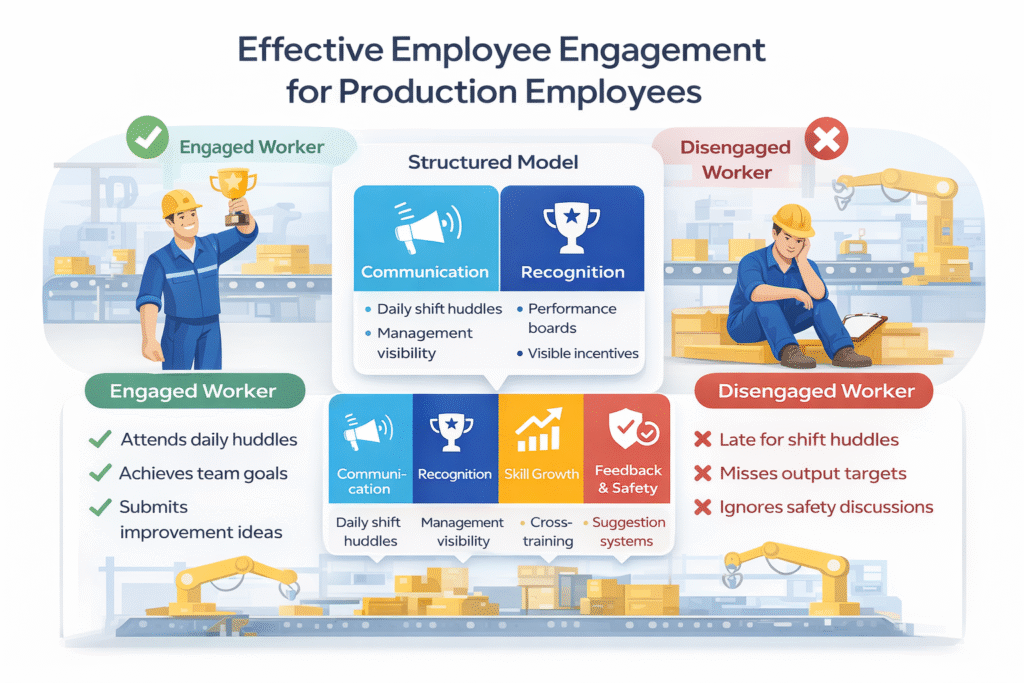
You can implement a 4-pillar engagement structure:
Pillar 1: Communication
Daily huddles + monthly townhall
Pillar 2: Recognition
Visible boards + safety rewards + team incentives
Pillar 3: Skill Growth
Cross-training + certification pathways
Pillar 4: Feedback & Safety
Suggestion systems + safety forums
This structured model improves engagement without large budgets.
Mini Case Study: Automotive Component Manufacturer
Problem:
High absenteeism
Low morale
Minimal participation in improvement initiatives
Intervention:
Daily shift briefings
Performance-linked team incentives
Skill certification ladder
Monthly safety recognition
Outcome:
Absenteeism reduced
Improved supervisor-worker communication
Increased productivity consistency
Engagement improved because the model respected operational realities.
Final Thoughts
Employee engagement activities for production employees are most effective when they are:
Visible
Measurable
Consistent
Practical
Linked to real work
Engagement is not about events. It is about systems that connect people to performance, safety, and growth. When engagement reflects operational realities, retention improves, productivity stabilises, and workplace culture strengthens naturally.
Frequently Asked Questions (FAQS)
The most effective activities include daily shift huddles, safety recognition programs, team-based performance incentives, skill development initiatives, and structured feedback channels tailored to factory environments.
Low-cost engagement strategies include recognition boards, safety milestone rewards, suggestion systems, structured communication routines, and multi-skilling programs.
Blue collar engagement focuses on safety, structured communication, recognition, and skill growth, while white collar engagement emphasizes autonomy, development, flexibility, and innovation opportunities.
HR should assess shift systems, communication access, safety conditions, and growth pathways before designing simple, measurable engagement initiatives aligned with production goals.
Examples include daily toolbox talks, performance dashboards, team incentives, safety suggestion schemes, and certification-based promotions.