Labour Migration Challenges in India: How LPG Disruptions Impact Workforce Stability
In recent times, global geopolitical tensions have started affecting everyday supply chains in subtle but important ways. One such impact is seen in LPG availability and pricing fluctuations, which directly influence access to cooking fuel for households across India.
For businesses, this may seem like a macro issue. But on the ground, it connects directly to labour migration challenges in India, especially for migrant workers who depend on stable access to basic utilities in urban areas.
When essential needs like cooking fuel become uncertain, workforce stability is affected.
Workers reconsider relocation, shift back to their hometowns, or become inconsistent in attendance. What appears as an external supply issue slowly turns into an internal operational challenge.
Understanding Labour Migration in India
India’s workforce includes a large segment of migrant labour that moves between rural and urban areas in search of better opportunities. These workers form the backbone of industries such as manufacturing, construction, logistics, and food processing.
However, migrant labour issues in India are often linked to more than just wages. They are deeply connected to:
access to housing
availability of essential utilities
cost of living in cities
portability of benefits like ration and LPG
overall living conditions
Reflective Question:
Are businesses only focusing on wages, or are they considering the complete living ecosystem of their workforce?
How LPG and Geopolitical Disruptions Affect Migrant Workers
Global supply chain disruptions and geopolitical uncertainties often influence fuel prices and distribution. LPG, being a critical household need, becomes a sensitive factor for migrant workers.
Challenges include:
Difficulty in accessing LPG connections in a new city
Lack of portability across states
Dependence on informal or shared arrangements
Increased costs due to supply fluctuations
Delays in cylinder availability
These LPG access issues for migrant workers create friction in daily life. When basic needs are not reliably met, workers begin to reassess their decision to stay in urban employment.
Example:
A manufacturing unit observed increased absenteeism during periods of LPG supply disruption. Workers preferred returning to their hometowns, where access to fuel and basic resources was more stable.
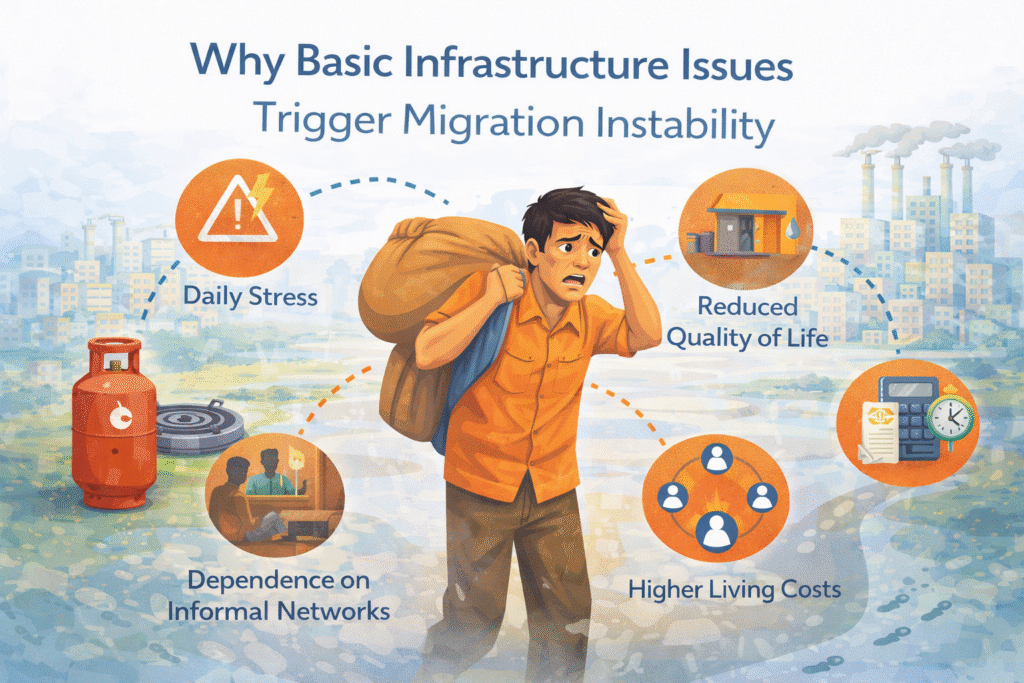
Why Basic Infrastructure Issues Trigger Migration Instability
Labour migration is not just an economic decision. It is a lifestyle decision.
When key essentials become uncertain, workers face:
higher daily stress
reduced quality of life
increased dependency on informal networks
higher living costs
These factors directly contribute to workforce migration problems such as:
seasonal return to hometowns
inconsistent workforce availability
higher attrition rates
difficulty in retaining skilled labour
Even when jobs are available, the lack of stable living conditions discourages long-term migration.
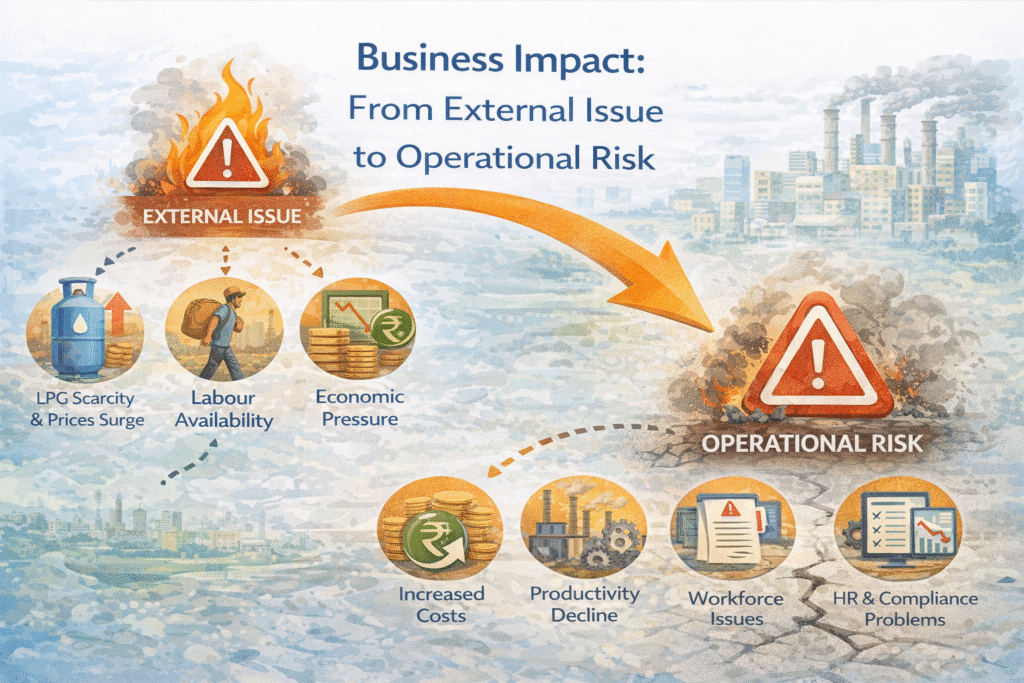
Business Impact: From External Issue to Operational Risk
For organizations, especially in manufacturing and operations-heavy sectors, these challenges translate into real business risks.
Impact areas include:
Workforce availability
sudden drop in attendance
seasonal workforce gaps
Operational efficiency
production delays
increased overtime costs
dependency on temporary labour
Cost implications
Higher hiring and training costs
reduced productivity
Planning challenges
unpredictable workforce supply
Difficulty in long-term capacity planning
These labour supply chain issues are often overlooked until they begin affecting output and delivery timelines.
HR Challenges in Managing Migrant Workforce
From an HR perspective, labour migration challenges in India create multiple complexities. Key challenges include:
Retention
Workers may leave not due to job dissatisfaction but due to living challenges.
Engagement
When basic needs are not met, engagement initiatives lose relevance.
Stability
Fluctuating workforce availability impacts team cohesion and performance.
Policy gaps
Many organisations do not have structured approaches to manage migrant workforce dependencies.
Reflective Question:
Is your HR strategy designed only for employees at work, or does it consider how they live outside work?
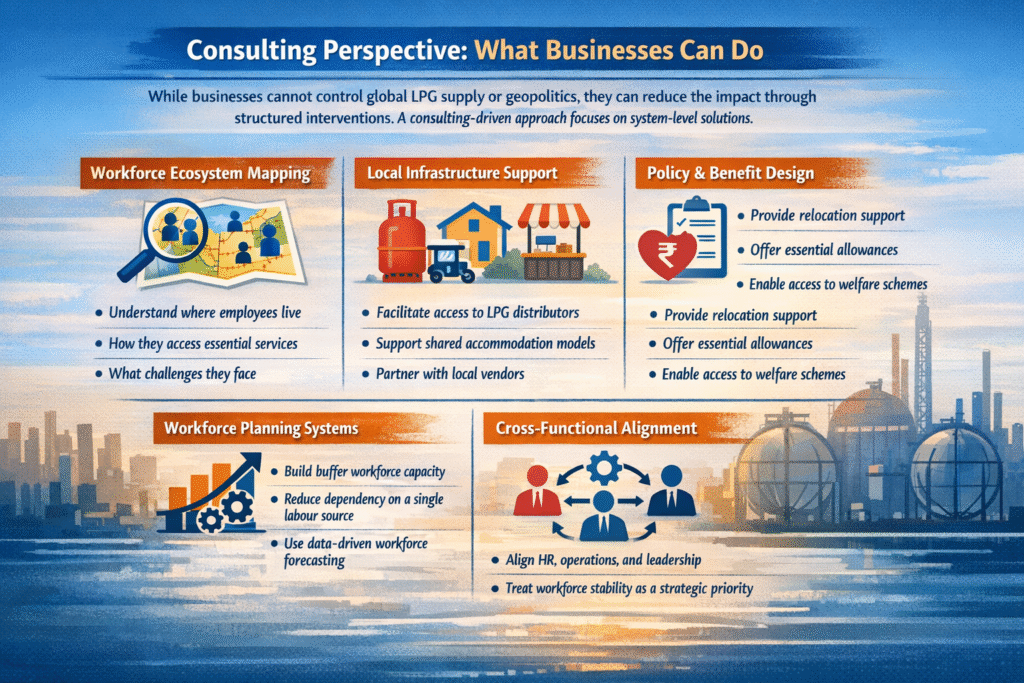
Consulting Perspective: What Businesses Can Do
While businesses cannot control global LPG supply or geopolitics, they can reduce the impact through structured interventions. A consulting-driven approach focuses on system-level solutions.
1. Workforce Ecosystem Mapping
Understand where employees live, how they access essential services, and what challenges they face.
2. Local Infrastructure Support
Facilitate access to LPG distributors
Support shared accommodation models
Partner with local vendors
3. Policy and Benefit Design
Provide relocation support
Offer essential allowances
Enable access to welfare schemes
4. Workforce Planning Systems
Build buffer workforce capacity
Reduce dependency on a single labour source
Use data-driven workforce forecasting
5. Cross-Functional Alignment
Align HR, operations, and leadership to treat workforce stability as a strategic priority, not just an HR function.
Mini Case Insight
A mid-sized manufacturing company faced recurring labour shortages during certain months. Initial assumptions pointed to wage dissatisfaction.
However, deeper analysis revealed issues related to LPG access and living conditions.
Intervention:
Partnered with local LPG distributors
Facilitated group access for workers
Improved accommodation coordination
Outcome:
Reduced workforce fluctuation
Improved attendance consistency
Better production planning stability
The solution was not increasing salaries. It was addressing a real-life constraint.
Final Thoughts
Labour migration challenges in India are often discussed at a macro level, but their real impact is felt inside factories, warehouses, and operational units.
When basic needs like cooking fuel are disrupted due to broader economic or geopolitical factors, workforce stability becomes uncertain. Businesses that recognize this connection early can design better systems to reduce disruption.
Growth does not depend only on strategy and execution. It also depends on how well organisations understand and support the realities of their workforce.
Frequently Asked Questions (FAQS)
Gas cylinder access issues create daily life challenges for migrant workers, increasing living costs and uncertainty, which often leads to workforce instability and migration back to hometowns.
Key challenges include access to housing, utilities like LPG, benefit portability, cost of living, and inconsistent working conditions in urban areas.
Companies can improve stability by supporting access to essential services, improving accommodation, designing better policies, and using structured workforce planning.
Labour migration affects workforce availability, increases hiring costs, disrupts production schedules, and reduces operational efficiency.
Effective strategies include ecosystem mapping, benefit support, engagement programs aligned with worker needs, and cross-functional workforce planning systems.
Related posts
- Micro-Strategies: Quick Wins for Big Impact
"Explore how Micro-Strategies deliver quick wins for big impact in businesses. Learn their benefits, examples, and practical applications...
- Pricing Models Types: Explained with Real-World Examples
"Learn about different types of pricing models with real-world examples. Discover which pricing strategy works best for businesses...
- Digital Transformation in Businesses: Key Strategies to Stay Competitive
Discover effective strategies for driving digital transformation in your business. Discover how CRM, ERP, data analytics, automation, and...