1. What Is Performance Management System and Why It Matters
Organisations often conduct annual appraisals and assume they have a structured performance approach. In reality, many businesses operate without a clear system that connects goals, accountability, and measurable outcomes. Understanding what is performance management system is essential before designing one.
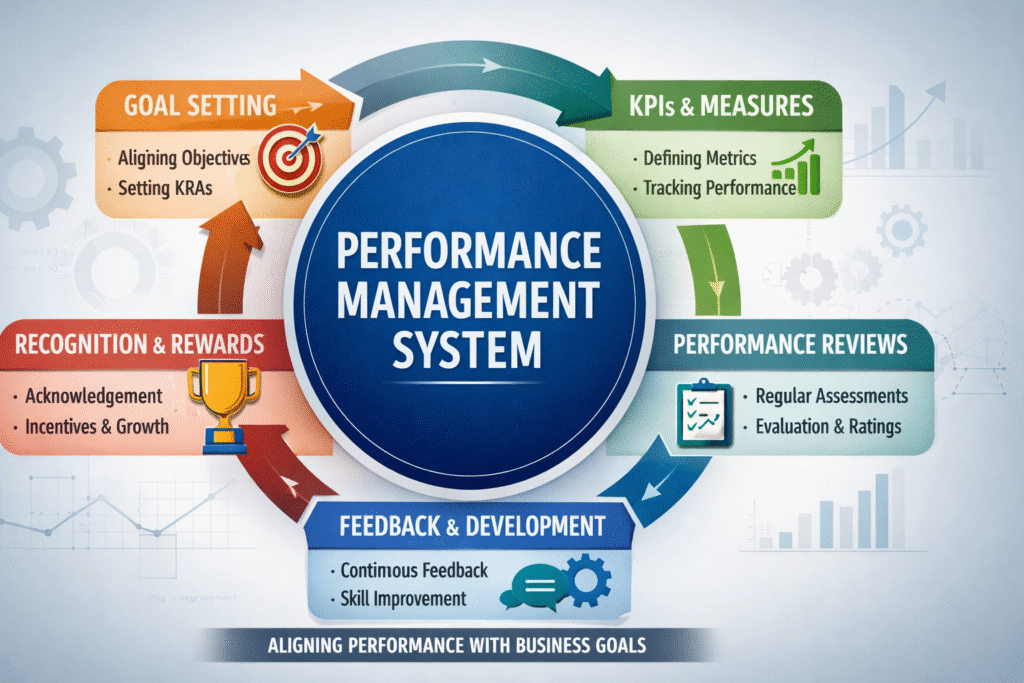
A performance management system is a structured framework that aligns individual roles with organisational objectives through goal setting, measurable KPIs, review cycles, and continuous feedback. It ensures performance is not evaluated subjectively but assessed against defined expectations and outcomes.
Without a structured performance management process, organisations face inconsistent evaluations, unclear accountability, and reduced employee engagement.
2. What Is Performance Management System in HR?
A structured system improves clarity and fairness across the organisation.
Key benefits include:
Clear alignment between business goals and employee objectives
Objective decision-making in promotions and rewards
Better visibility into performance gaps
Stronger accountability at all levels
Improved employee engagement and retention
Reflective Question:
Are performance discussions in your organisation driven by measurable results or influenced by perception?
According to research published by the Society for Human Resource Management (SHRM), structured performance systems significantly improve organisational effectiveness and employee satisfaction.
Source: https://www.shrm.org/
3. Key Components of a Performance Management System
A professional performance management system framework typically includes the following components:
1. Goal Setting
Goals should be specific, measurable, and aligned with organisational strategy.
Business-level goals
Department-level goals
Individual KRAs
Example: If the company goal is revenue growth of 20%, the sales team KRA may focus on conversion rates and pipeline growth, while marketing may focus on lead quality and cost per acquisition.
2. KPIs and KRAs
Clear KPIs and KRAs in performance management define measurable expectations.
Output-based metrics
Efficiency indicators
Quality measures
Behavioural expectations
This reduces ambiguity and ensures fairness in evaluation.
3. Performance Reviews
A structured performance review system includes:
Quarterly or bi-annual reviews
Data-backed discussions
Self-assessment components
Manager evaluation
Improvement planning
The difference between a structured performance management process and a simple appraisal lies in continuity and data alignment.
4. Continuous Feedback and Development
Modern performance management best practices focus on continuous improvement.
Ongoing check-ins
Development planning
Training identification
Coaching support
Research from Harvard Business Review highlights that continuous feedback systems outperform annual-only appraisal models in employee engagement and productivity.
4.How to Implement a Performance Management System
Implementing a performance management system requires structured design.
Steps typically include:
Define organisational objectives
Align department goals
Create role-based KRAs
Define measurable KPIs
Establish review cycles
Train managers on evaluation consistency
Monitor and refine the framework
Reflective Question:
Does your organisation have documented evaluation criteria, or does each manager assess performance differently?
5. Performance Management System Example
onsider a mid-sized manufacturing company experiencing uneven performance across teams.
Before implementation:
No structured KPIs
Annual appraisal only
No documented KRAs
Promotion decisions perceived as inconsistent
After implementing a structured employee performance management system:
Defined KRAs for each role
Monthly performance dashboards
Quarterly structured reviews
Clear performance improvement plans
Result:
Improved accountability
Reduced internal conflicts
Clearer promotion pathways
Better productivity tracking
6. Common Mistakes in Performance Management
Even organisations with formal systems make errors such as:
Copy-paste KPIs without role alignment
Measuring activities instead of outcomes
Ignoring behavioural competencies
Conducting reviews without documented criteria
Linking compensation without transparent logic
A poorly implemented performance appraisal system can create more dissatisfaction than having no system at all.
Conclusion
Understanding what is performance management system is not about defining terminology; it is about designing clarity into organisational performance. A structured system connects goals, roles, accountability, and measurable outcomes into a continuous cycle.
When implemented correctly, performance management improves fairness, transparency, and long-term business results. When neglected, it creates confusion and inconsistency that directly impacts growth.
Frequently Asked Questions (FAQS)
A performance management system in HR is a structured framework that aligns employee goals with organisational objectives through KPIs, review cycles, and continuous feedback mechanisms.
The key components include goal setting, KRAs and KPIs, structured performance reviews, continuous feedback, and development planning.
Designing a performance management system for SMEs requires aligning business priorities with role-based KRAs, defining measurable KPIs, and establishing consistent review cycles without adding unnecessary complexity.
Performance appraisal is a periodic evaluation process, whereas a performance management system is a continuous, structured approach to improving and tracking performance.
A structured performance management system improves accountability, aligns teams with strategic goals, and supports data-driven decisions that strengthen overall business performance.
Related posts
- How to Attract Skilled Talent: Creating a Workplace People Choose
"Learn what Change Management is, why it’s critical for businesses, key models, challenges, and real-world examples of successful...
- What Is Performance Management System and Why It Matters
"Learn what Change Management is, why it’s critical for businesses, key models, challenges, and real-world examples of successful...
- Best Employee Engagement Activities for Production Employees
"Learn what Change Management is, why it’s critical for businesses, key models, challenges, and real-world examples of successful...